

As your baby reaches a new stage of development each week of pregnancy, your body also prepares for childbirth. Knowing which tests should be performed during each week not only satisfies your curiosity but also helps potential risks be identified at the appropriate time. The purpose of regular prenatal care is not to perform as many tests as possible, but to protect the health of both mother and baby by carrying out the right examinations at the right time.
When Should Prenatal Care Begin?
You should contact an obstetrician and gynecologist when a home pregnancy test gives a positive result. The timing of the first examination is determined according to the date of your last menstrual period, your current symptoms, and your previous pregnancy history.
During an early ultrasound examination, the doctor evaluates whether the gestational sac is located inside the uterus, determines the gestational age, and assesses the development of the embryo. The time at which the baby’s heartbeat can be detected may vary according to the date of ovulation. It can generally be detected around the sixth week. If a heartbeat cannot be detected during the very early weeks of pregnancy, this does not necessarily indicate a problem.
Pregnancy Week Calculator
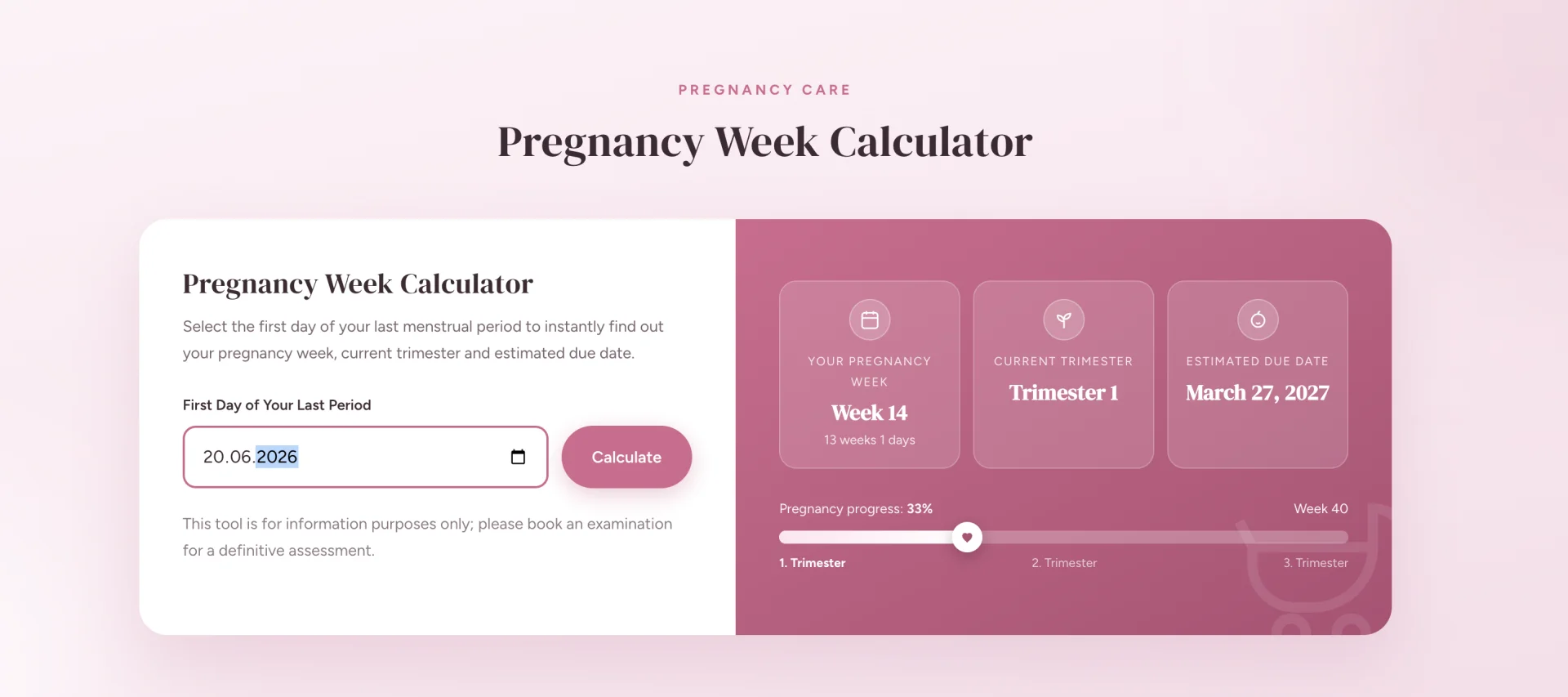
You can use our pregnancy week calculator to determine your current gestational week and trimester. By entering the date of your last menstrual period, you can find out how many weeks pregnant you are, which trimester you are in, and your estimated due date.
Which Tests Are Performed During Each Week of Pregnancy?
-
Weeks 4–8: The location of the pregnancy within the uterus, the number of gestational sacs, the gestational age, and the fetal heartbeat are evaluated.
-
Weeks 8–10: A complete blood count, blood group testing, urinalysis, and any necessary infection screenings are planned.
-
Weeks 11–14: Nuchal translucency is measured. The doctor determines whether first-trimester combined screening or a cell-free fetal DNA test using maternal blood is necessary to assess the risk of chromosomal abnormalities. These tests may also be performed at the family’s request.
-
Weeks 18–22: The baby’s organs, placenta, amniotic fluid, and development are examined using a detailed ultrasound.
-
Weeks 24–28: Gestational diabetes screening, a complete blood count, and other necessary examinations may be performed.
-
Weeks 28–32: The baby’s growth, the amount of amniotic fluid, and the condition of the placenta are evaluated when clinically indicated.
-
Weeks 32–36: The baby’s development and position, as well as findings that may affect the delivery plan, are assessed.
-
Weeks 36–40: Appointments may become more frequent. The baby’s position, the cervix, fetal movements, and signs of labor are evaluated.
This schedule is provided for general informational purposes. Not every test needs to be performed during the same week or at the same frequency in every pregnancy.

What Is Evaluated During the First Trimester?
During the first trimester, the location and viability of the pregnancy are assessed, and the estimated due date is calculated. The expectant mother’s blood pressure, weight, chronic conditions, current medications, and previous pregnancies are also reviewed.
Screening tests performed between weeks 11 and 14 estimate the risk of certain chromosomal abnormalities. Screening tests do not provide a definitive diagnosis. If a high-risk result is obtained, genetic counseling and diagnostic tests may be considered.
During Which Week Is a Detailed Ultrasound Performed?
A detailed ultrasound is usually performed between weeks 18 and 22 of pregnancy. The baby’s brain, face, spine, heart, abdominal organs, and limbs are examined in detail and documented in a report. The location of the placenta, the cervix, and the amount of amniotic fluid are also evaluated.
It is important to understand that even a normal ultrasound cannot definitively exclude every disease or developmental difference. The ultrasound should be performed and evaluated by an obstetrician and gynecologist.
During Which Week Is the Glucose Screening Test Performed?
Gestational diabetes screening is generally performed between weeks 24 and 28. Earlier assessment may be recommended for people who developed diabetes during a previous pregnancy, are overweight, or have a family history of diabetes.
Because gestational diabetes often causes no symptoms, it cannot be identified solely by evaluating the patient’s complaints. Diagnosis is important for adjusting nutrition, monitoring blood glucose levels, and protecting the health of both mother and baby.
How Frequently Are Appointments Scheduled During the Third Trimester?
Prenatal appointments should generally become more frequent as delivery approaches. During each examination, blood pressure, weight changes, swelling, uterine growth, and the baby’s heartbeat should be carefully assessed.
A non-stress test (NST) or Doppler ultrasound is not required at every appointment. These examinations may be considered when there is a reduction in fetal movement, a growth problem, high blood pressure, diabetes, or a pregnancy that has progressed beyond the expected gestational period.
How Are High-Risk Pregnancies Monitored?
Multiple pregnancy, high blood pressure, diabetes, thyroid disease, a history of premature birth, recurrent miscarriage, or concerns about the baby’s development may require closer monitoring.
In high-risk pregnancies, appointments may be scheduled more frequently, and additional ultrasounds, Doppler examinations, non-stress tests, or laboratory tests may be planned. The monitoring schedule is personalized according to the expectant mother’s individual risk factors.
Which Symptoms Are Dangerous During Pregnancy?
You should not wait until your next scheduled appointment if any of the following occur:
-
Vaginal bleeding or leakage of amniotic fluid
-
Severe or one-sided abdominal pain
-
Fainting, shortness of breath, or chest pain
-
Severe headache and visual disturbances
-
Sudden swelling of the face and hands
-
Fever, persistent vomiting, or inability to drink fluids
-
A noticeable reduction in the baby’s movements
-
Regular contractions that become progressively more intense
Sudden swelling, a severe headache, and visual disturbances may be associated with pregnancy-related hypertension. If these symptoms occur, you should contact your doctor without delay.
Conclusion
Week-by-week prenatal care not only monitors your baby’s development but also helps protect the expectant mother’s health. Because every pregnancy progresses differently, the examination and testing schedule should be personalized. Through regular prenatal examinations performed by İzmir obstetrician and gynecologist Op. Dr. Sadık Sözdinler, your baby’s development can be monitored, the necessary tests can be planned during the appropriate weeks, and you can prepare safely for childbirth.
Frequently Asked Questions
When Can the Baby’s Movements Be Felt During Pregnancy?
During a first pregnancy, fetal movements are generally felt between weeks 18 and 22. People who have previously given birth may notice these movements earlier.
Can a Vaginal Ultrasound Harm the Baby?
A vaginal ultrasound performed by an experienced doctor does not harm the baby. It may provide clearer images during early pregnancy.
Is Fasting Required for Every Blood Test During Pregnancy?
No. Whether fasting is required depends on the test being performed. You should ask your doctor or the laboratory for instructions before the test.
Can Dental Treatment Be Performed During Pregnancy?
Necessary dental treatments can be performed during pregnancy when appropriate precautions are taken. The dentist should be informed about the gestational week and any medications being used.
Is Air Travel Safe During Pregnancy?
Air travel may be possible up to a certain stage in uncomplicated pregnancies. The gestational week, flight duration, and individual risk factors should be evaluated before traveling.
Should Vitamins Be Taken During Pregnancy?
Yes, vitamins and supplements may be used during pregnancy, but you should always consult your doctor beforehand. Folic acid, iron, vitamin D, and other supplements should be taken at the dosage recommended by your doctor. Unnecessary or excessively high doses may be harmful.
This article is intended for informational purposes only and does not constitute medical advice, diagnosis, or treatment.
Op. Dr. Sadık Sözdinler | Obstetrician, Gynecologist, and Genital Aesthetics Specialist
Quick Appointment
Fill out our contact form now, and we will get back to you as soon as possible.